Resume & Applications
Applying before grades or a final writing sample
Find out what the employer accepts before replacing a missing transcript or unfinished memo. Retrieve the right school record, disclose the sample's context and keep the later update tied to the original application.

Penn Carey Law Class of 2027 · Updated Nov 16, 2026 · 6 min read
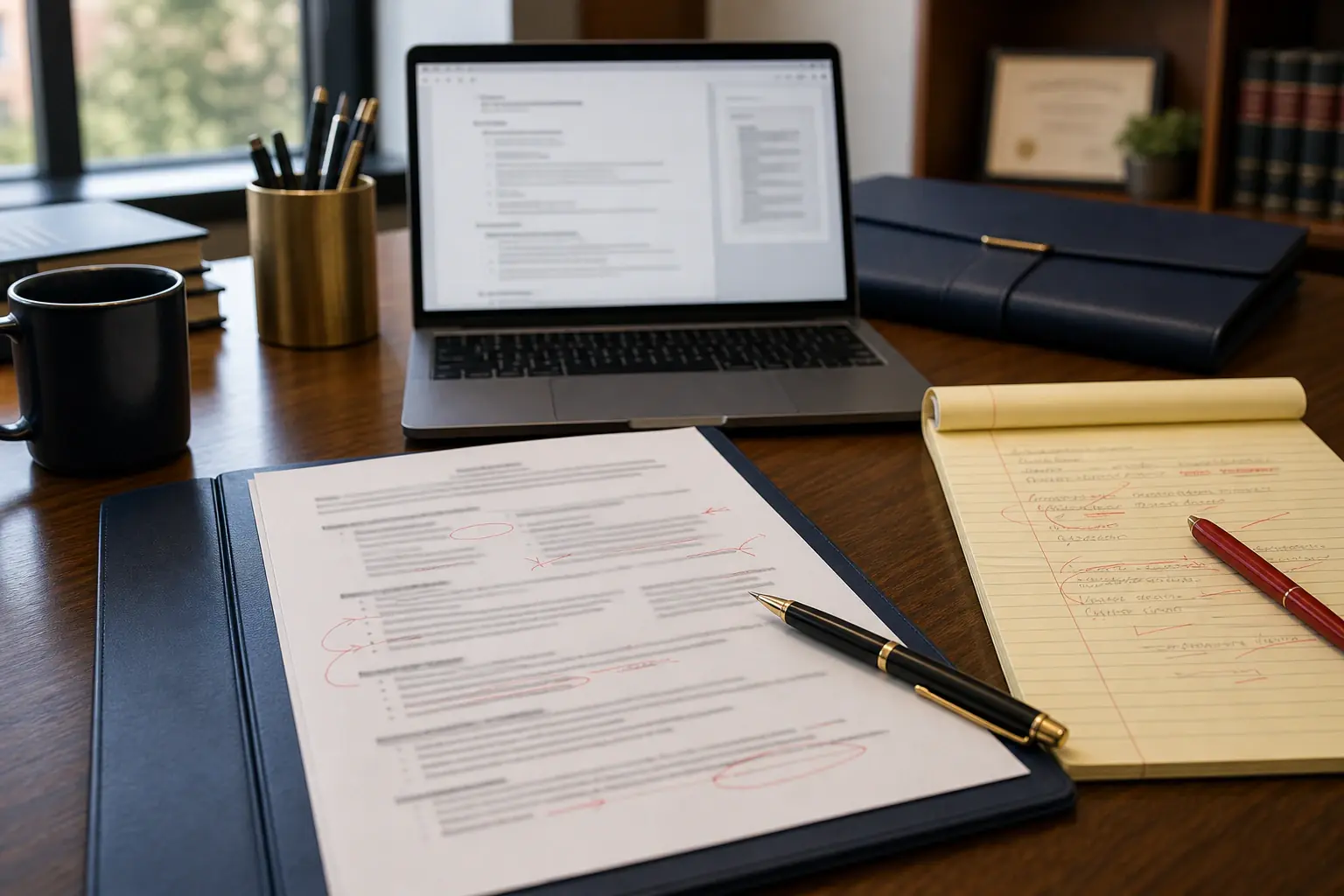
An application can open before your first law-school grades are available or before your legal memo is ready to share. The useful next step is to identify what the employer requires now. It is not to invent a grade record, relabel an enrollment letter as a transcript, or upload a draft that you do not have permission to share.
Separate the two missing items
Write down whether you are missing a school record, a usable writing sample, or both. Then read the actual program's instructions. "Transcript required" does not tell you whether an unofficial current record is acceptable, and "writing sample" does not tell you that an unfinished memo will satisfy the requirement.
Some employers explicitly address this situation. For example, Judge AliKhan's official internship instructions allow first-year students to apply before fall grades and require an updated packet once a complete transcript is available. That is evidence about those instructions, not permission to assume the same process elsewhere.
If the answer is missing, use the verified recruiting channel to ask one narrow question before the deadline. Record the response with the particular role, office and program year.
Retrieve the actual school record
Start on your law school's official registrar page or authenticated student portal. Locate its transcript instructions, distinguish official from unofficial records, and check whether the current record is available before grades. Menu labels and turnaround times differ by school.
If you cannot find the record, ask the registrar what it can issue now: a current transcript without grades, an enrollment verification, or another official explanation. These documents are different. Send an alternative only if the employer confirms that it is acceptable, and describe it accurately.
Check which education level was requested. An undergraduate transcript does not replace a law-school transcript unless the employer says so. Do not upload your own table of anticipated grades or present a course list as an academic record.
Before sending, open the document and confirm your identity, school, record type and whether grades have been released. Check for holds or administrative steps through your own school's instructions. Do not assume another school's processing estimate applies to yours.
Choose a sample you can actually share
Yale's writing-sample guidance emphasizes employer directions, permission for employer work, confidentiality and disclosure of editing. Apply those checks before deciding which document looks most impressive.
Possible routes to ask about include an earlier completed piece of your own writing, a permitted excerpt, a clearly identified draft, or supplying the sample later. These are questions to resolve, not universally accepted substitutes.
An unfinished class memo may have collaboration, circulation or assignment restrictions. Confirm your course rules before sharing it. If feedback has not been returned, say that accurately; do not describe the sample as professor-approved. If you revise it after receiving feedback, distinguish your own revision from substantive edits by another person.
Do not use client work without the required permission, even if you removed a name. Redactions can leave identifying facts, comments, metadata or other confidential information. Ask the appropriate supervisor what may be shared and how to prepare it.
Use a cover sheet with a limited purpose
A cover sheet can explain context; it cannot cure missing permission or make an unresponsive sample satisfy the employer's instructions. The free writing-sample cover sheet prompts you to identify the assignment, authorship, editing, permissions, redactions and any excerpt.
Follow the employer's actual length and file-format requirements. Avoid treating a suggested page range from a general guide as a firm rule. Do not shrink the text until the document is unreadable merely to reach a page count.
Check citations in a separate editing pass
Use the citation manual and edition assigned for the course or required by the employer or court. This checklist is a review process, not a replacement rulebook. Formatting can differ between an academic piece and a practitioner document; do not apply one set of conventions indiscriminately.
- Source identity: open the actual authority and verify its name, court or issuing body, date and citation. A search snippet or an automated citation is not enough to establish the source.
- Support and pinpoint: compare the sentence with the exact cited passage. Confirm that the page, paragraph or section points to that passage in the version you used. Do not confuse a PDF viewer's page counter with a printed reporter page.
- Signal: check how the authority supports the proposition. Cornell's signals guide distinguishes direct support, additional support, analogy and contrary authority. Choose the accurate relationship and then check the assigned manual's formatting; a decorative signal cannot repair missing support.
- Short form: make sure the reader can identify the full authority from a shortened reference. Cornell's short-form guide emphasizes that connection. Recheck immediate back-references after moving, adding or deleting a citation; an earlier editing decision may no longer point where you intended.
- Quotation and explanation: compare quotations with the original, check omissions or alterations under the assigned rules, and verify that your explanation describes what the authority actually did. Do not turn dicta or a separate opinion into the court's holding.
- Final file: read the exported document again for broken characters, lost italics, comments, missing pages or line breaks that changed meaning. Preserve the version you actually submitted.
Georgetown's writing-sample handout recommends separate proofreading passes. Keep substantive source checking separate from surface formatting so a neat citation does not create false confidence in the underlying analysis. Ask a course-approved writing or library resource about a rule you cannot resolve, while respecting restrictions on outside assistance.
Plan the later update once
Keep the initial application reference and the file versions you sent. When grades or a permitted final sample become available, check the official update channel and use the grade or materials update script. Do not create a duplicate application unless instructed.
If the portal accepts an updated file, record that event. It is different from knowing that a recruiter opened it or replaced every earlier copy. If the employer does not accept updates, do not send the same attachment repeatedly to unrelated lawyers.
Your next action is small: retrieve the current registrar instructions or ask the employer one precise question. The direct-application guide covers the surrounding application workflow; your own task list can hold the actual update date you confirm.
Save this guide
Keep it in your free account and get email alerts before recruiting deadlines.
Firms open summer 2028 applications on their own schedules, and new ones open every week.
Keep Reading

What to do after bad 1L grades
A disappointing semester changes your recruiting strategy. It does not give you enough information to declare your legal career over.
 Tulio Tagliaferri, Founder · Nov 16, 2026
The BigLaw cover letter guide
A cover letter is a short explanation of why this application makes sense. It should not repeat the resume, perform passion, or become a second personal statement.
Tulio Tagliaferri, Founder · Nov 16, 2026
BigLaw salary scale 2026 and summer associate pay
Market scale is a benchmark, not a promise from every firm. Here is how base salary, class year, bonuses, offices, and summer associate pay fit together.
Tulio Tagliaferri, Founder · Nov 16, 2026